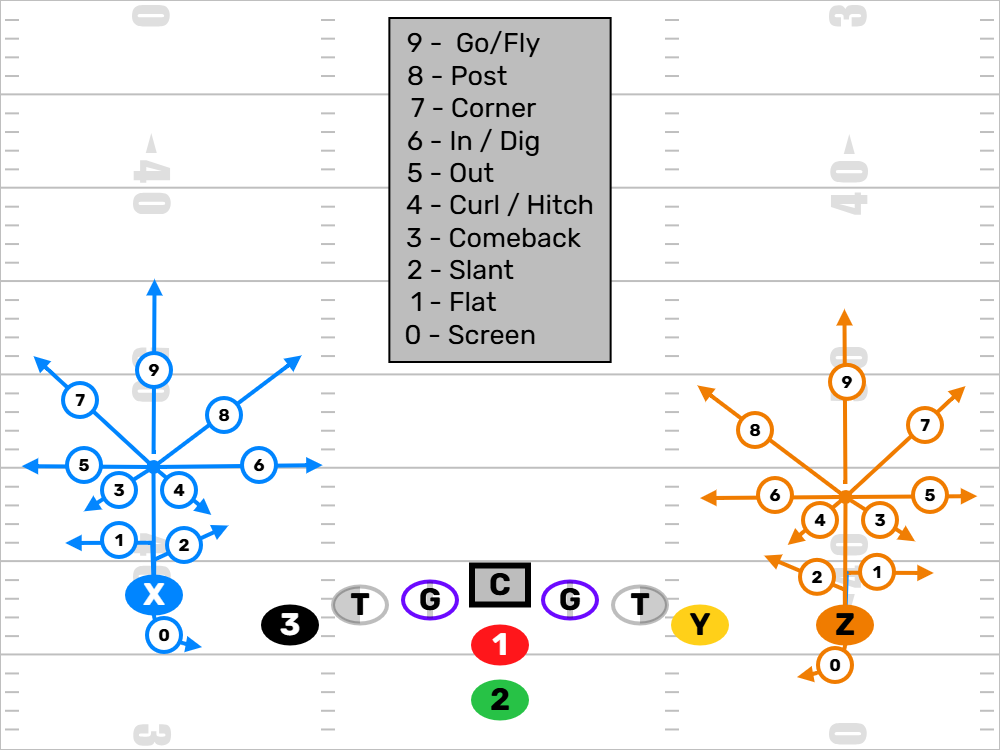
If you’re coaching wide receivers at the youth level, your job goes far beyond teaching them how to catch. A great receiver understands the full picture—alignment, leverage, coverage, and the role they play even when the ball isn’t coming their way.
Start with the basics: know when you’re on the line and when you’re off. That matters for spacing, timing, and staying legal. Teach your guys how to line up right every time.
Next, emphasize physicality. Every receiver has to block. I don’t care how talented he is with the ball—if he won’t block on the perimeter, he’s a liability. Blocking is non-negotiable.
Now onto releases. Start simple but set a foundation: outside release when it's called, especially on a Must Outside Release (MOR). Teach them how to use their hands, set up the defender, and get vertical with purpose. They need to understand how to win leverage, not just run fast.
Then, layer in the mental side. Can your receivers identify if the middle of the field is open or closed? Do they know how that affects a post route vs. a dig? Teach them what the defense is showing—and how to adjust accordingly.
You don’t need a playbook full of route tags. You need a receiver room that knows why they’re doing what they’re doing. That’s how you build a reliable, explosive passing game—starting with Football 101.
Let’s coach it right.
Below are fundamental routes every young receiver should know. These are the foundation for building more advanced concepts.
0.1 Screen: Bubble
Setup: Slot or outside receiver. Time your drop step to get behind the line.
Directions: Backpedal or slide outside to receive the ball behind the LOS while other WRs block in space.
Tips: Secure the catch first, then attack the alley with urgency. Use your blockers.
0.2 Screen: Slip
Setup: Wide receiver aligned near the sideline (outside or slot). Quarterback in shotgun.
Directions: Take one quick step upfield or backward to show pass, then turn and look for the ball. Catch it behind the line of scrimmage as blockers set up in front.
Tips: Be quick and stay low. Catch the ball cleanly, then get upfield fast. Trust your blockers to create a lane.
0.3 Screen: Tunnel
Setup: Outside or slot receiver. Start with a vertical or angled stem.
Directions: Take 1–2 steps upfield, then loop back inside behind the LOS toward the QB. Catch and follow inside blockers.
Tips: Don’t drift upfield. Let the tunnel form, then hit it at full speed once the catch is secure.
1. Flat
Setup: Usually from a tight or slot alignment. May motion to adjust leverage.
Directions: Release horizontally toward the sideline, staying flat and gaining width.
Tips: Get your head around quickly—this is often a hot read or first look in progression.
2. Slant
Setup: Start with an inside foot back. Lean inside to threaten vertical then break sharp.
Directions: Take 1–3 steps vertically, then break at a 45° angle across the defender’s face.
Tips: Speed is critical. Win early. Use a subtle jab step if needed to get inside leverage.
3. Comeback
Setup: Boundary side or isolated WR spot. Must sell vertical.
Directions: Push vertically to roughly 5 yards, then break back toward the sideline at a 45° angle.
Tips: Stay low and come out of the break flat. Don’t drift upfield. Timing with the QB is everything.
4. Curl / Hook / Hitch
Setup: Wide or slot. Match depth to the concept (usually 8–12 yards).
Directions: Push vertical, snap down quickly, and come back to the QB, staying square.
Tips: Work into the soft spot of zone. Show strong hands and be ready to get vertical after the catch.
5. Out
Setup: Outside alignment with space from sideline. May motion for leverage.
Directions: Push vertical to 5 or 10 yards, then break sharply at 90° toward the sideline.
Tips: Stay flat on your break. Do not round it. Timing route—ball is coming out quick.
6. In (Dig)
Setup: Mid or wide split. Use inside leverage off the line.
Directions: Push vertical to 5 or 10 yards, then break inside across the field at 90°.
Tips: Stay flat and accelerate through the route. Expect contact and work through it.
7. Corner
Setup: Outside release preferred. Sell post to force the DB inside.
Directions: Stem to 5 yards, then break at a 45° angle toward the pylon or sideline.
Tips: Keep eyes upfield and don't tip the break. Lean inside just before cutting.
8. Post
Setup: Outside release with vertical stem. Room to cut inside is essential.
Directions: Break at 5 yards on a 45° angle toward the center/post.
Tips: Sell go route before snapping inside. Make the cut crisp and accelerate through the catch window.
9. Go / Fade / Fly
Setup: Any alignment. On the outside, use a split-release to beat press.
Directions: Sprint vertical at full speed. Stay outside the numbers unless stacked.
Tips: Don’t look for the ball too early. Stack the DB or win outside leverage and hold your line.